During your initial 90-minute appointment (60mins face to face and 30mins for clinical documentation), your child’s psychologist will discuss your areas of concern and goals during a parent-only session. Over the first couple of sessions with your child, they’ll engage your child in informal, play-based assessment in order to truly understand both their strengths and challenges. Where appropriate your child’s psychologist will bring in more formal types of assessment which can assist with measuring progress over time, help other key people in your child’s life understand their strengths and difficulties and support applications for funding, or the renewal of funding.
Your child’s psychologist will write an Interim Therapy Support Summary to provide information that was gathered from the assessment, make recommendations and set interim goals for therapy until more formal goals are set in collaboration with you as the parent.
We encourage our psychology clients attend regular appointments at the same time every week or fortnight. This consistency is helpful for all our clients, but especially our Neurodivergent kids and parents, as it helps them integrate therapy sessions into their routine, while making steady progress towards their goals.
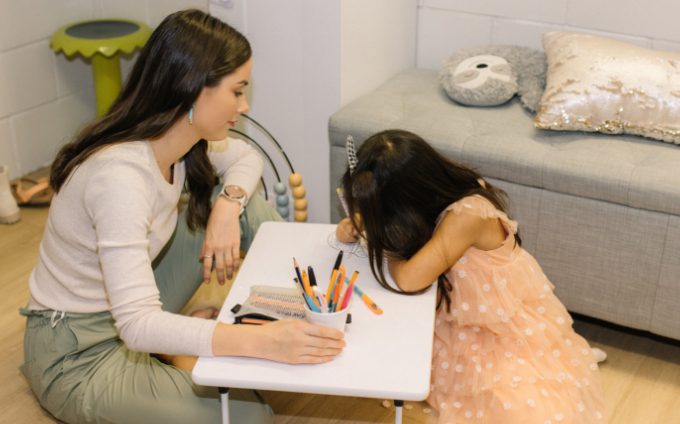
A regular psychology session runs for 70 minutes (50mins face to face and 20mins for clinical documentation) and involves engaging your child in conversation and play-based activities as we work on specific goals. Every psychology session takes place in a fun, safe, and supportive environment that allows your child to be their authentic self and engage in a way that feels therapeutic to them. For some children this might be climbing up the monkey bars or creating a magnetic tile building, it might be craft or it could be having the chance to speak about things that have been challenging for them.
Our psychology service is evidence-based and we draw upon the latest research to inform how our service operates. Our approach is family-centred, neurodiverse affirming and trauma informed which means relationship is at the centre of all we do.
We offer a range of funding options. Many of our clients have NDIS funding (we accept self-managed or plan-managed funding only). If you do not have an NDIS plan, you may be able to get a GP referral to help cover the cost of therapy through a Mental Health Care Plan which can attract a Medicare rebate for up to 5-10 sessions per year. We also accept GP Medicare Plans (often known as Team Care Arrangements), as long as your plan has at least three sessions nominated to one of our therapists. You may also be entitled to rebates on your Health Fund. All of our fees are in line with the current NDIS pricing guide. We welcome all enquiries about pricing.


A child psychologist supports children in understanding and managing their emotions, behaviour, and thoughts. They use play, conversation, and evidence-based strategies to help children build self-awareness and confidence in a way that makes sense for their developmental stage.
Psychology can support children who experience anxiety, emotional regulation difficulties, behavioural challenges, low confidence, friendship difficulties, attention challenges (such as ADHD), or learning differences. It can also be helpful for children going through family changes, school transitions, or other life stressors.
For younger children, parents are often involved in the first session and may join in parts of therapy to learn strategies for supporting their child at home. For older children and teens, the psychologist may meet with the child one-on-one, and offer parent coaching and opportunities for parent feedback as necessary.